
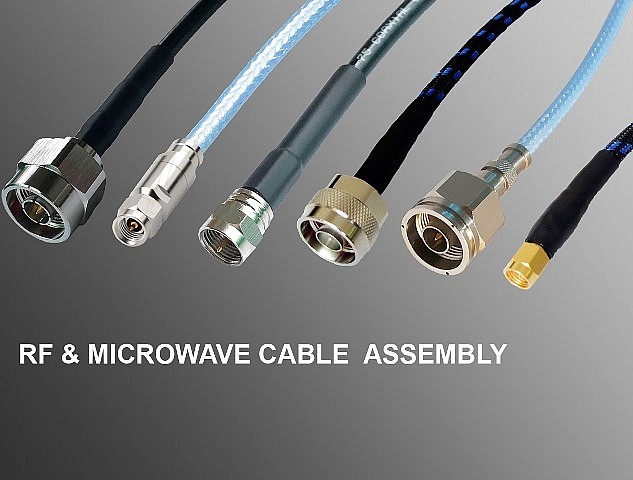
RACOMTECH is a professional RF & Microwave technology company, our RF &...
Read moreFilter
Catalog
- –Test instruments
- –Coaxial Cable & Assemblies
- –RF Components
- –RF Connectors
- –Coax Adapters
- –2.92mm
- –3.5mm
- –4.3/10 to N, 716
- –BNC - UHF
- –F to BNC
- –In series BNC
- –In series DIN 716
- –In series N type
- –In series RP-SMA
- –In series SMA
- –In series TNC
- –In series UHF
- –N Type - BNC
- –N Type - DIN716
- –N type - F adapter
- –N type - MCX
- –N type - RP-SMA
- –N Type - SMA
- –N type - SMB
- –N Type - TNC
- –N Type - UHF
- –RP-SMA / RP-TNC
- –SMA - F adapter
- –SMA - RP-SMA
- –SMA / BNC Adapter
- –SMA / TNC adapters
- –SMA / UHF adapters
- –TNC / RP-SMA / BNC
- –K 2.92mm
- –3.5mm
- –N type
- –QMA
- –SMA
- –TNC
- –7/16 DIN
- –4310
- –BNC
- –FME
- – F
- –MCX
- –SMB
- –UHF
- –Coax Adapters
- –Tools & Soldering Station
- –Custom Design
- –Clearance Centre
Information
LatestCable Catalogue
Ournews
-
03/31/2025
The outer conductor size of these connectors prevents the mating of incompatible connectors....
Read more -
04/01/2018
The VSWR ( The voltage standing wave ratio ) is a measure of impedance match of load to the transmission...
Read more -
03/21/2018
Simplified EMI PreCompliance & Debug RSA5000 SERIES SPECTRUM ANALYZERS High Performance Real-Time...
Read more
RF Spectrum Analysers
EYou Electronics Australia supplies RF spectrum analysers and real-time spectrum analyzers for RF, wireless, EMI/EMC and laboratory testing. Explore RIGOL DSA and RSA spectrum analysers for general RF measurements, interference analysis, EMI pre-compliance and advanced real-time spectrum analysis, with Australian sales and support from Melbourne.


1) RF Spectrum Analysers for RF Testing and Signal Analysis
An RF spectrum analyser is an essential test instrument for measuring signal amplitude versus frequency. It allows engineers and technicians to identify RF signals, harmonics, spurious emissions, interference, occupied bandwidth and unwanted signals that may not be visible with a conventional oscilloscope.
EYou Electronics Australia supplies RIGOL spectrum analysers for RF engineering, electronics development, wireless communications, education, production testing and laboratory applications.
Our range includes conventional swept spectrum analyzers and real-time spectrum analysers, allowing customers to select an instrument according to frequency range, resolution bandwidth, noise floor, real-time bandwidth and measurement requirements.
Whether you are troubleshooting an RF circuit, checking transmitter harmonics, locating interference or performing EMI pre-compliance measurements, choosing the correct spectrum analyser can significantly improve measurement accuracy and efficiency.
How to Choose an RF Spectrum Analyser
When selecting an RF spectrum analyser, consider the following key specifications.
Frequency Range
The analyser must cover both the fundamental signal and any harmonics or spurious signals that need to be measured.
For example, testing a 2.4 GHz wireless device may require considerably more than 2.4 GHz measurement capability if higher-order harmonics also need to be investigated.
EYou offers RIGOL spectrum analyser solutions covering a range of RF measurement requirements, from general-purpose instruments to higher-frequency RF analysis systems.
Resolution Bandwidth – RBW
Resolution bandwidth determines the analyser's ability to distinguish signals that are close together in frequency.
A narrower RBW can separate closely spaced signals and improve the ability to observe low-level signals near stronger carriers, although narrower bandwidth settings can increase sweep time on traditional swept spectrum analysers.
Displayed Average Noise Level – DANL
DANL is an important specification when measuring weak RF signals.
A lower noise floor allows smaller signals to be detected and measured. Applications involving low-level spurious emissions, RF receiver development and EMI troubleshooting can particularly benefit from good DANL performance.
Phase Noise
Phase noise becomes important when examining weak signals close to a strong carrier.
For RF oscillator, synthesizer and communication-system measurements, the phase-noise performance of the spectrum analyser can determine whether low-level nearby signals can be clearly identified.
Tracking Generator
A spectrum analyser equipped with a tracking generator can also be used for scalar transmission measurements.
This is useful for evaluating devices such as:
- RF filters
- attenuators
- amplifiers
- cables
- splitters and power dividers
- other RF components
For customers regularly testing RF components, selecting a spectrum analyser with a tracking generator can substantially expand the instrument's capabilities.
2) Swept Spectrum Analyser vs Real-Time Spectrum Analyser
A traditional swept spectrum analyser sweeps across a selected frequency range and measures the RF spectrum sequentially. It is suitable for many common RF measurements, including signal level, harmonics, filters, amplifiers and general troubleshooting.
A real-time spectrum analyser (RTSA) continuously processes a defined bandwidth and can capture signals that may be difficult to observe using conventional swept measurements.
Real-time spectrum analysis is particularly useful for:
- intermittent RF interference
- transient signals
- frequency-hopping signals
- pulsed RF signals
- wireless communication troubleshooting
- rapidly changing RF environments
RIGOL RSA series instruments provide real-time spectrum analysis capabilities for engineers who need to capture and investigate dynamic RF signals.
For routine laboratory and production measurements, a conventional swept spectrum analyser may provide excellent value. For transient or intermittent signals, an RTSA may be the more appropriate choice.
3. Spectrum Analysers for EMI and EMC Pre-Compliance Testing
Spectrum analysers are commonly used during product development for EMI/EMC pre-compliance testing.
Engineers can use a suitable spectrum analyser with near-field probes, antennas and other accessories to locate unwanted RF emissions before sending a product to an accredited EMC test laboratory.
Depending on the analyser and available options, useful EMI measurement features may include:
- EMI resolution bandwidths
- peak detection
- average detection
- quasi-peak detection
- limit lines
- frequency markers
- low-noise measurement capability
Pre-compliance testing does not replace formal compliance testing by an accredited laboratory, but it can help identify potential EMC problems earlier in the design process and reduce costly redesign and repeated laboratory testing.
4) RF Spectrum Analyser Applications
RF spectrum analysers are widely used in:
RF Engineering – Measure carriers, harmonics, spurious signals and RF power levels.
Wireless Communications – Analyse Wi-Fi, Bluetooth, ISM-band and other wireless signals.
RF Interference Troubleshooting – Identify unwanted or intermittent signals within an RF environment.
Amplifier Testing – Examine output spectrum, harmonics and unwanted emissions.
Oscillator and Signal Generator Testing – Check output frequency, harmonics and spectral characteristics.
Filter Testing – A spectrum analyser with a tracking generator can measure the relative frequency response of RF filters.
EMI Pre-Compliance – Locate and investigate conducted or radiated RF emissions during product development.
Education and Research – Observe and analyse RF signals in electronics and communications laboratories.
5) RF Test Equipment and Accessories from EYou Australia
EYou Electronics Australia supplies more than spectrum analysers. Our RF and microwave product range includes RF test cables, coaxial adapters, attenuators, terminations, DC blocks, power dividers and other components used with RF measurement equipment.
This allows engineers and laboratories to source both RF test instruments and measurement accessories from an Australian RF specialist.
For assistance selecting a spectrum analyser, consider providing us with your required:
- maximum measurement frequency
- minimum signal level
- real-time analysis requirement
- tracking generator requirement
- EMI measurement requirements
- application and budget
Our team can then help identify a suitable RIGOL spectrum analyser for your application.
6. Frequently Asked Questions
What is an RF spectrum analyser?
An RF spectrum analyser measures signal amplitude over frequency, allowing engineers to observe RF carriers, harmonics, interference, spurious emissions and other frequency-domain characteristics.
What is the difference between a spectrum analyser and an oscilloscope?
An oscilloscope primarily displays signal amplitude against time, while a spectrum analyser displays signal amplitude against frequency. Spectrum analysers are particularly useful for examining RF frequency content, harmonics and interference.
What is a real-time spectrum analyser?
A real-time spectrum analyser continuously captures and processes signals within its real-time analysis bandwidth. This makes it useful for detecting intermittent, transient and rapidly changing RF signals.
Do I need a tracking generator?
A tracking generator is useful when measuring the relative transmission response of RF components such as filters, cables and attenuators. If your main requirement is analysing transmitted or received RF signals, a tracking generator may not be necessary.
Can a spectrum analyser be used for EMI testing?
A suitable spectrum analyser can be used for EMI troubleshooting and pre-compliance measurements, particularly when combined with appropriate near-field probes or antennas. Formal regulatory compliance testing should be performed using the required compliant equipment and accredited test procedures.
Which RIGOL spectrum analyser should I choose?
The appropriate model depends on frequency range, RBW, DANL, phase noise, real-time bandwidth, tracking-generator requirements and your application. Contact EYou Electronics Australia with your measurement requirements if you need assistance selecting a model.
 $1,408VSWR Bridge and DSA800-VSWR software for Rigol Spectrum Analyzers. The VB1080's range is from 2-8 GHz
 $1,840EMI-DSA800, NFP-3 & S1210 BUNDLE
 $839EMI-DSA800, NFP-3 & S1210 BUNDLE
 $1,251High stability timebase option for the RSA3000 Series Real time Spectrum analyzers sources
 $1,015Preamplifier option, 100kHz to 3.2GHz (only for DSA832 or DSA832-TG)
 $1,015Preamplifier option, 100kHz to 7.5GHz (only for DSA875 or DSA8375-TG)
 $1,300DSA Accessories Package including?cables, adaptors, and antennas.
 $225Soft Carrying Bag for a DSA1000 Series or DSA1000A Series Spectrum Analyzer.
 $972VSWR Measurement Kit (DSA815 Only), ( VSWR Bridge not included)
 $542Rack Mounting Kit for a DSA1000 Series or DSA1000A Series Spectrum Analyzer. May be different than image. Rack kits are different for each instrument.
 $933Advance Measurement Kit for DSA1000 Series
 $1,537800 MHz to 4 GHz VSWR Bridge for DSA1030-TG and DSA1030A-TG
 $543Software for the DSA800, DSA1000 and DSA1000A series spectrum analyzers to be used within the UltraSigma package.
 $1,056Advanced Measurement Kit (DSA815Only)
 $1,278EMI Filter & Quasi-Peak Detector Kit (DSA815 Only)
 $839EMI-DSA800, NFP-3 & S1210 BUNDLE
 $1,263Rigol VB-1020 VSWR Bridge for Spectrum anaylzer DSA815TG, VSWR Bridge and DSA8-VSWR Software Upgrade for Rigol Spectrum Analyzer
 $1,925The market leading low price of the DSA-700 series makes them ideal entry point spectrum analysers for industry, education and hobbyists.
 $2,773The market leading low price of the DSA-700 series makes them ideal entry point spectrum analysers for industry, education and hobbyists.
 $2,401The Rigol DSA815 is a compact and light Spectrum Analyzer with premium performance for portable applications. The use of digital IF (intermediate frequency) technology guarantees reliability and performance to meet the most demanding RF applications.
 $2,365The Rigol DSA815-TG is a compact and light Spectrum Analyzer with premium performance for portable applications. The use of digital IF (intermediate frequency) technology guarantees reliability and performance to meet the most demanding RF applications.
 $7,181DSA832 series is one of RIGOL's compact size, light weighteconomic spectrum analyzers, the digital IF technology guarantees its reliability and performance to meet the most demanding RF applications.
 $3,181DSA832E series is one of RIGOL's compact size, light weighteconomic spectrum analyzers, the digital IF technology guarantees its reliability and performance to meet the most demanding RF applications.
 $4,135DSA832E Spectrum Analyzer DSA832 series is one of RIGOL's compact size, light weight economic spectrum analyzers, the digital IF technology guarantees its reliability and performance to meet the most demanding RF applications.
 $6,836$5,999DSA832 Spectrum Analyzer DSA832 series is one of RIGOL's compact size, light weight economic spectrum analyzers, the digital IF technology guarantees its reliability and performance to meet the most demanding RF applications.
 $9,332DSA875 Spectrum Analyzer DSA875 series is one of RIGOL's compact size, light weight economic spectrum analyzers, the digital IF technology guarantees its reliability and performance to meet the most demanding RF applications.
 $12,262DSA875 Spectrum Analyzer DSA875 series is one of RIGOL's compact size, light weight economic spectrum analyzers, the digital IF technology guarantees its reliability and performance to meet the most demanding RF applications.
 $235Rigol DS-CASE High Quality Nylon Carry Case for DSA815TG, DG4000, DS2000
 $3,210High quality real-time spectrum analyzer from 9 kHz to 1.5 GHz bandwidth, up to 10 MHz real-time bandwidth, 10 Hz - 10 MHz RBW and a 25.6 cm (10.1") touch display with 1024x600 pixel.
 $3,566High quality real-time spectrum analyzer from 9 kHz to 1.5 GHz bandwidth, up to 10 MHz real-time bandwidth, 10 Hz - 10 MHz RBW and a 25.6 cm (10.1") touch display with 1024x600 pixel.
